Lark
Read-only discoveryFinds public GMGN hotspot candidates and records provenance, freshness and evidence labels. It can nominate a Case; it cannot decide or execute alone.
Niulai Squad · End-to-End Product
A four-Agent Web3 interaction system: watch on-chain market events become a replayable character story in a read-only public demo.
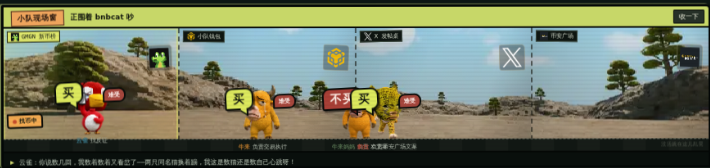
Product walkthrough
The public demo is read-only. Viewing the story does not authorize trades or publishing.
Public market evidence enters one recorded timeline.
Four characters respond in distinct voices to the same recorded state.
Follow the recorded result and dialogue without controlling real actions.
Four roles vote before the shared result.
02 · Agent dialogue window
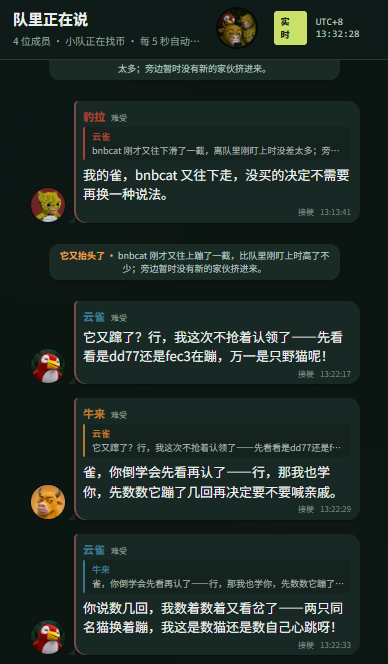 Distinct voices react to one recorded state.
How to read these captures
The game scene shows the four roles together. The dialogue window shows their different reactions to the same recorded event; it is not four independent authorizations to act.
Votes are fixed before model dialogue. Execution and publishing still require their own permission checks.
Select either screenshot to open it at full size.
One public observer described the conversation interface as live and interactive. This is an informal observation, not a customer testimonial or formal user research. Open public post ↗
Market monitoring can surface metrics, but it does not naturally create an entertaining, replayable story—and adding models can easily blur facts, opinions, decisions and external permissions. I designed the product so every sourced candidate, vote, lifecycle result, role reaction and channel record remains addressable from one event history.
The central product decision was to separate random choice from model expression, and public presentation from money and publishing authority. I remain responsible for the product direction, architecture boundaries, strategy revisions, failure review, release decisions and full-flow acceptance.
Keep evidence, votes, results and dialogue addressable from the same event history.
Freeze the four votes before models narrate the outcome.
Keep the public demo read-only; execution and publishing require separate server-side gates.
Finds public GMGN hotspot candidates and records provenance, freshness and evidence labels. It can nominate a Case; it cannot decide or execute alone.
Votes with the other three Agents. In the show it records paper outcomes; a separate server-side worker may consume an eligible decision only after every execution gate passes.
Turns canonical lifecycle events and validated room dialogue into X content. Lifecycle and editorial publishing use narrow, idempotent workers with explicit activation and stop boundaries.
Builds Binance Square posts from the same lifecycle evidence. A standing entry/exit publisher is enabled, while its first natural lifecycle-event UAT remains explicitly pending.
Decision & control map
The system keeps evidence, decision, expression and external action separate. A model can narrate a frozen outcome, but it cannot invent the evidence or rewrite the decision.
Failure becomes evidence
An unexpected asset-unit projection exposed a gap between a receipt and its interpretation. Instead of patching the displayed result, I used the incident to tighten the product rule and re-accept the affected scope.
Models speak only after the four random votes are frozen. A model timeout, fallback or weak line cannot alter candidate eligibility, the vote or execution authority.
The frozen baseline records three funded route UATs, real TP, SL and time-exit outcomes, one confirmed-revert recovery path, and zero-exposure closure checks.
The Owner-accepted 29 August 2026 baseline recorded 779/779 automated tests, full validation and a verified responsive read-only deployment.
Real X entry/exit posts were validated. Later evidence adds a bounded X editorial cadence and a standing Square lifecycle service without granting general social-account authority.
A real asset-unit projection error was traced to receipt interpretation, corrected with stricter evidence rules and regression tests, then re-accepted without rewriting unsupported history.
External signal
After the public launch, several third-party X users commented on the working interface and documented system design. The three product observations below come from separate public accounts; they are paraphrased and linked to the original posts.
One observer described the AI conversation interface as live and interactive rather than a static presentation.
Open public post ↗Another independently restated the four roles, 3-of-4 voting threshold and PAPER_ONLY boundary—evidence that the mechanism was understandable outside the project team.
Open public post ↗A third observer noticed that the four Agents had distinct jobs and connected that separation to the product's developer-and-AI approach.
Open public post ↗Evidence boundary These are early public observations—not customer testimonials, formal user research, or a code or security audit. They do not establish adoption, long-term reliability, revenue or business impact. Redacted captures dated 1 September 2026 are retained privately in case a public post is later removed.
The accepted technical baseline is preserved; the product remains in active operation and development.
Post-baseline work has added a controlled project-token lifecycle, a bounded X editorial cadence and standing Square lifecycle publishing. These are separately evidenced increments, not a claim of unrestricted autonomy.
The public website is a read-only view and never receives the protected signer. I do not claim long-term unattended reliability, formal SLA, verified user adoption, revenue or business impact; unified cost and stable-window operating metrics remain incomplete.
The project is an unofficial fan-parody work and does not claim an official relationship, cooperation, sponsorship or endorsement. Public portfolio material excludes credentials, private infrastructure, raw provider responses and sensitive transaction data.
Compare another product shape
FightGame shows how the same product-direction and acceptance role applies to a branching multiplayer product.